
Declawing
Cats: |
 |
 |
Declawing a cat is the same as cutting a human's fingers off at the knuckle.
This is a very controversial subject. For me this has been something I wanted to write about for a long time! I love my cat's as much as I love my human family and the act of declawing makes my stomach turn inside out.A cat's claws are used to capture prey, for climbing, and in self-defense. Claws are an integral part of a cat's life, but their use can also be a problem for cats' human cohabitants. Declawing, however, is a painful and permanently crippling procedure that should not be practiced. There are effective and humane alternatives to declawing that can reduce or eliminate clawing damage.
The awakening at the veterinarian's office the morning after you were there for what you thought was a routine examination. Instead, to your dismay, there are bandages on your front paws and certain handy little appendages have been permanently removed. Pain throbbing terribal pain in all 4 of your little paws.
Cats claw to maintain proper condition of the nails, for fun and exercise, and to mark territory visually as well as with scent. They stretch by digging their claws into something and pulling back against their own clawhold. A cat's natural instinct to scratch serves both physical and psychological needs. Before domestication, cats satisfied these needs by clawing tree trunks. Domesticated cats can be trained to satisfy their desire to claw without damaging valuable property.
Note the strong ligaments and tendons which give power to extend and retract the claws in the drawing:
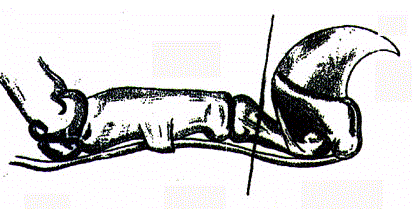
When the end digit including the claw is removed, the sensory and motor nerves are cut, damaged and destroyed. They do not repair themselves or grow back for many months. There follows a wooden lack of feeling, then a tingling sensation during the long convalescence. The cat must walk on the stub end of the second digit. Sometimes a claw grows back, but not in the normal way. Rather, they grow up through the top of the paw creating a bloody sore. The physical effect of declawing is gradual weakening of the muscles of the legs, shoulders and back. Balance is now impaired. Declawed cats must feel defenseless and certainly live with more stress in their lives. Despite its grace, a cat is not sure- footed. Without the ability to grasp with its claws, it can easily be injured in a fall.
Declawing involves several separate, painful amputations:
There are several misconceptions
about declawing. It does not make cats more "mellow."
Declawed cats may be morose, reclusive, and withdrawn, or they
may be irritable, aggressive, and unpredictable. Many people
think declawing makes a cat safer around babies, but this is far
from true, as the lack of claws turns many cats into biters.
Declawed cats feel so insecure, lacking their first line of
defense, that they tend to bite more often as a means of
self-protection.(11)
People who have their cats declawed simply do not understand how
important claws are to a cat and do not know how else to deal
with the problem. With a little effort and commitment to your
cat's welfare, you can eliminate the excuse to declaw your cat
and make him or her a better companion as well.
To train a kitten or to retrain an adult cat requires the following measures:
Regular nail trimmings.
When the cat is relaxed and unafraid, gently press on the toes
until the claws extend. Use a pair of animal nail trimmers and
cut only the tip of the nail, taking care not to damage the vein
or quick. The nail "hook" is what tears up upholstery,
so when it is removed, damage is greatly reduced.
Buy or build two or more
scratching posts.
Such posts must be sturdy, tall enough to allow the cat
to completely stretch (3 feet or taller), and properly placed. A
bark-covered log, a post covered with sisal, or a tightly woven
burlap-covered post works well. Soft, fluffy, carpeted scratching
posts don't work -- they are one of the greatest causes of
declawing because cats often don't like the posts, and frustrated
human companions resort to surgery.
If you use carpet, secure it to the posts with the rough backing
on the outside; soft carpeting will not satisfy a cat's need to
claw. Place one scratching post where the cat is already clawing,
and another close to where he or she normally sleeps (cats like
to stretch and scratch when they first wake up). An excellent
scratching post is available from Felix Co., 3623 Fremont Ave.
N., Seattle, WA 98103; 206-547-0042.
Another option is the cardboard or sisal "scratching
box," which lies flat on the floor. These are inexpensive
and small enough to scatter around the house, allowing your cat
easy access to an "approved" scratching spot at all
times. They do wear out fairly quickly, however, and will need to
be replaced every few months -- otherwise, cats may get
frustrated and revert back to using furniture.
Give your cat specific
instructions as to where to claw and where not to claw.
Place your cat on the new scratching post and move his or her
paws, or pretend to scratch it yourself. This will scent the
posts and encourage exploratory clawing. Make the post a
"fun" place to be. Play games with your cat on and
around the post and attach hanging strings, balls and/or bouncy
wire toys to it. Sprinkle catnip on the post, too. (A once-a-week
or so "refresher" application will keep your cat
interested.) When kitty uses the post, reinforce this behavior
with praise, but be careful not to startle or frighten him or
her. When the cat claws furniture, discourage this behavior with
a firm voice or other loud noise, but never with physical force.
Lukewarm water from a squirt gun directed at the back of the
animal is often successful. During the training period, you may
need to cover upholstery with plastic or other protection (cats
don't like the slippery feel and will quickly learn to stay
away).
Another option is Soft Paws Nail Caps for Cats, available c/o Smart Practice, 3400 East McDowell, Phoenix, AZ 85008-7899. Soft Paws are soft, vinyl nail caps that are applied to cats' newly trimmed nails. The nail caps allow cats to scratch naturally, without harming furniture. Each application lasts about four to six weeks.
An excellent book that will help you understand your cat better is The New Natural Cat by Anitra Frazier, Campman and Co., Bridgeport, Conn., 1981 (available from Felix Co.). By understanding cat behavior and by using common-sense precautions and behavior modification methods, you can prevent clawing damage without inflicting pain on your feline companion.
1.Townsend, Jean B., "How to
Deal With Your Cat's Claws," Maryland Feline Society, Inc.,
1982.
2.Marsden, Donna, "Cats With Claws: It's Only Natural,"
Washington Humane Society News, Spring 1995, p. 3.
3.Riddle, Roz, The City Cat, Charles Scribner Sons, p. 40, 1984.
4.Place for Cats, New York, N.Y., 1993.
5.Wilbourn, Carole C., Cats Prefer It This Way, Coward, McCann
& Geoghegan, 1976.
6.Townsend, op. cit.
7.Barton, Florence, D.V.M., "Ask the Vet," Cat Fancy.
8."Declawing: Convenient But Cruel?," PAWS News, Feb.
1989.
9."Paws Come With Claws," Friends of Animals brochure.
"Paws Come With Claws -
That's One
Of Natures Laws"
Copyright © 2006 - Cicki Hasselblad, Linköping,
Sweden - All
rights reserved.
Send all questions and comments to mail to:
cicki@hasselblads.com
Last revised:
March 27, 2006